
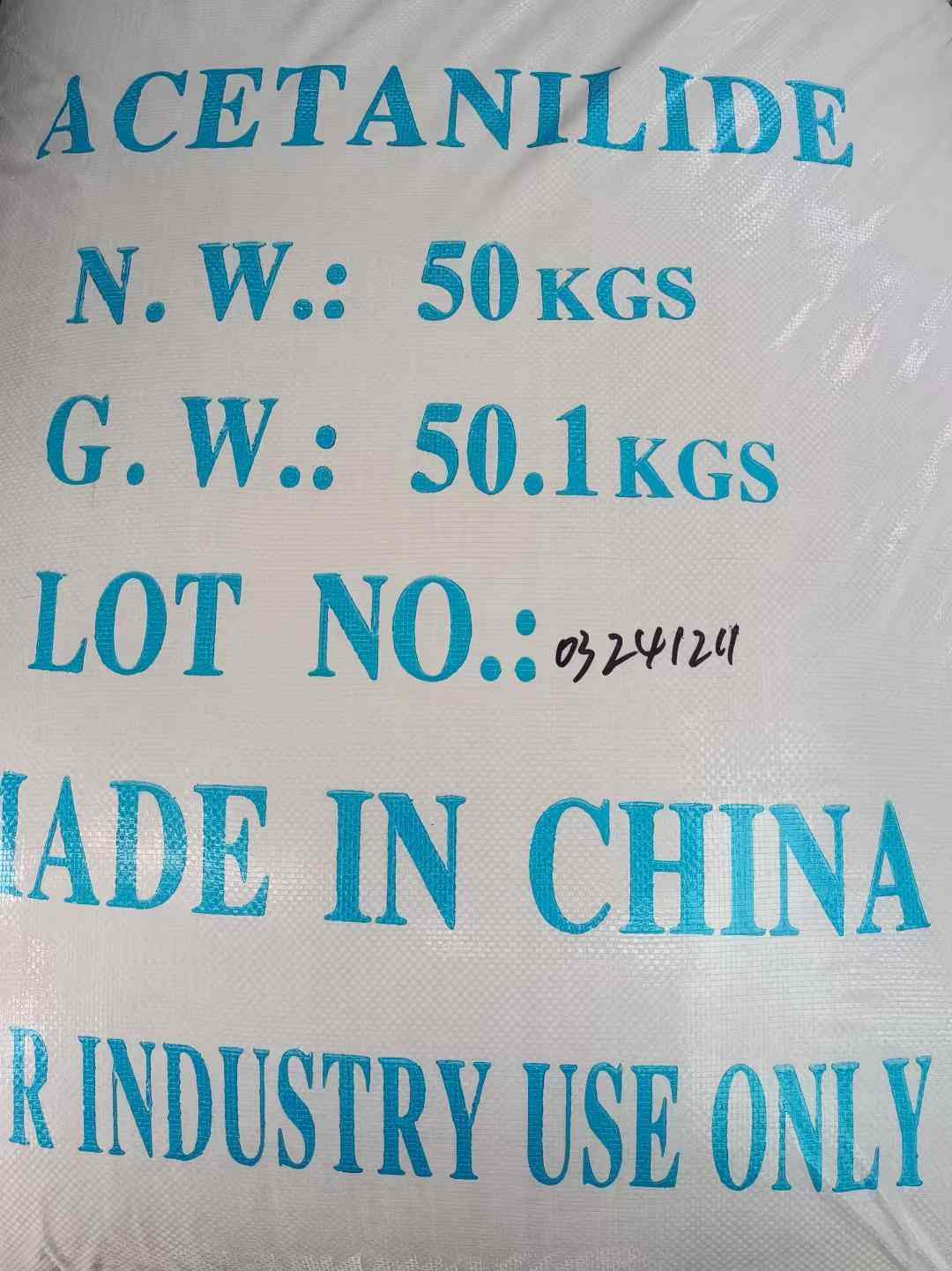
ACETANILIDE / CAS 103-84-4 / CHINA SUPPLIER
Industrial-Grade Acetanilide for Dye Intermediates — Shipped to India & Southeast Asia
Shipped from China. Tell us your quantity, application, and destination country.
Quick Specifications
| Product Name | Acetanilide |
|---|---|
| CAS No. | 103-84-4 |
| Appearance | White powder |
| Assay | ≥98.8% |
| Free Aniline | ≤0.2% |
| Moisture | ≤0.25% |
| Packing | 25kg / 50kg bag |
| MOQ | 1 container |
| Lead Time | About 1 month |
| Sample | Available |
| Documents | Latest COA / MSDS on request |
Historical batch results may be better than the standard specification. Contact us for the latest batch document.
Zhengzhou Saihang Chemical supplies industrial-grade Acetanilide to dye intermediate manufacturers. We run a bulk-oriented supply chain out of China, with a focus on stable purity and on-time container shipments.
Most of our export volume moves to India and Southeast Asia through trading partners. Standard packing is 25kgs/50kgs bag; container loads can be arranged with full documentation.
Supply Snapshot
- Packing
- 25kg / 50kg bag
- MOQ
- 1 container
- Lead time
- About 1 month
- Sample
- Available
- Documents
- Latest COA / MSDS on request
Acetanilide is used as a raw material in dye intermediate production — azo dyes, pigments, and colorant chemistry. Tell us your spec and destination market; we’ll match packing and documentation to your requirements.
Direct inquiries welcome
For product details, pricing, or document requests, email us directly.
tonyliu@saihangchem.comExperience with trading-partner channels means shipments move through customs without documentation delays.
Bulk supply, steady quality
We keep a tight loop on incoming batches and outgoing QC. The goal is no stock-out surprises and no last-minute specification changes.
Documents and samples, fast
Need a COA or MSDS for internal review? We usually turn those around within one working day. Samples ship within a few days of request.
Common Questions
Q1. Can I get a sample before placing a bulk order?
Yes. We provide samples for evaluation and internal qualification. Lead time for sample dispatch is usually a few days.
Q2. What documents come with a standard shipment?
Latest COA and MSDS are available on request. If your customs or QA team needs additional paperwork, let us know when you inquire.
Q3. What is the typical lead time to India?
About one month from order confirmation, depending on port and current vessel schedule. We have handled over 20 container batches to India via trading partners.
Q4. Do you accept orders smaller than one container?
Our standard MOQ is one container. For smaller trial quantities, sample support is the best first step.
Send an inquiry
Tell us your quantity, application, and destination port. We will reply with product details, pricing, and document support.
Prefer email? Reach us at tonyliu@saihangchem.com
We respect your privacy. Your information will only be used to respond to your inquiry.